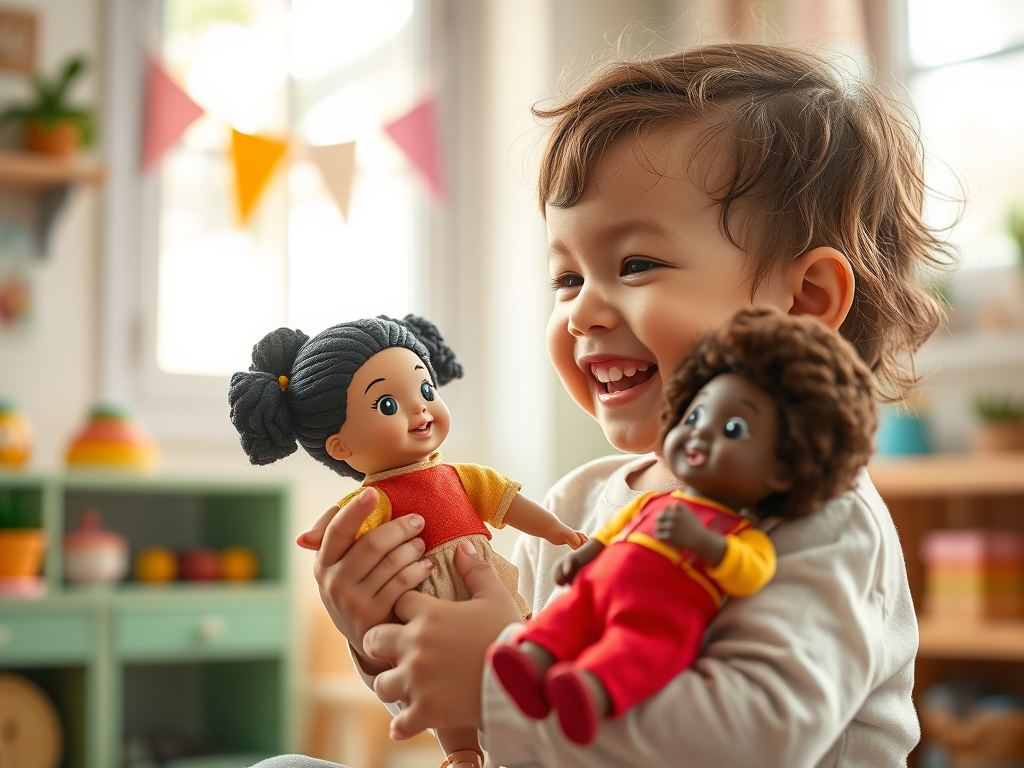
Anyone who has the pleasure of working with toddlers will know that big feelings, emerging language, potty training, and navigating the tricky world of sharing (or not sharing!) are dominating factors of their world. Amid all these milestones It could be easily missed that they are also forming ideas about race and perceptions of identity but although much of this is taking place internally it is very much part of the terrific toddler period.
How Perceptions of Race Develop from Babyhood
Toddlers are not blank slates; their perceptions of the world begin forming long before they can articulate them. With 80% of a child’s brain developed by the age of three, it stands to reason that their perceptions of diversity are also taking shape during this critical period.
As discussed in my previous blog, by three months of age, babies show a preference for faces that match the race of their primary caregivers. Research indicates that this preference is not due to inherent bias but rather a reflection of familiarity, babies are drawn to what they see most often (Quinn et al., 2002). This highlights a vital opportunity to prevent the formation of later biases by exposing children to diverse faces from an early age.
By toddlerhood, these perceptions become more deeply embedded but educators still have the opportunity to positively influence them. Research shows that by around age two, children may begin to consider race when making decisions such as choosing who to play with. This suggests they need regular opportunities to see people from other races in positive, familiar contexts to feel comfortable engaging with them (Katz & Kokin, 1997). While some children vocalise the racial differences they notice, others internalise these observations as they navigate their expanding social world.
One moment that stayed with me involved a two-and-a-half-year-old I had cared for since she was seven months old. Seemingly out of nowhere, she took my hand, smiled, and commented, “You have brown skin,” before looking back at her own hand. At first, I wondered if this was the first time she had noticed our skin colour differences. Later, I realised it was more likely that she had always noticed but was only now making sense of it and developing the language to express her observations.
This moment didn’t happen by chance. Leading up to it, this child had been immersed in a setting that celebrated diversity: her white caregivers at home, her black key person at nursery, and the diverse community surrounding the setting all contributed to her understanding. The nursery had also been intentional in linking with the local community and enabling the environment to weave diversity in, making it a normal part of her daily experiences.
Contrast this with situations where children grow up with limited exposure to racial differences. While on holiday in areas lacking diversity, I’ve observed white children reacting to my black family with responses ranging from fascination to fear. These interactions raise a critical question: if diversity remains an unusual or irregular occurrence in a child’s world, how does this shape their future attitudes toward race?
Starting with ourselves
It’s clear that the environment and resources play a critical role in creating inclusivity, helping children see themselves and others represented. While resources and books are often the first solution and may seem like an easy fix, they should be just one part of a broader commitment to fostering racially inclusive environments for toddlers. The commitment starts with us—our values, vision, and ethos. This is a longer and deeper process than the thrill of buying new resources, but so necessary! Without these foundational elements, even the most well-resourced environment will fail to make a meaningful impact.
Creating an inclusive environment
When we are ready to think about resources and the environment our considerations need to go deep enough for them to make a difference. We often prioritise quality over quantity but in this case, I believe that you need both. A good example of this is the role play area, a crucial space for toddlers as they begin exploring and making sense of their world through imaginative play. Including one or two non-white dolls may seem like a step toward inclusivity, but not only is it tokenistic, it’s also representative of the common societal tendency that we don’t want to bring into our role play “othering” non-white identities. It’s also easy for these token dolls to become overshadowed by the majority of white dolls lessening the impact further.
Ask yourself: Why can’t we have as many non-white dolls as white dolls? This is an important question to reflect on, regardless of the demographics of your cohort. Overrepresentation should not be a concern when the aim is to provide balanced and authentic diversity in your resources. When evaluating quality, look at whether your non-white dolls authentically represent facial features and hair textures that reflect their ethnicity. Dolls that are merely replicas of white dolls in a different colour fail to provide genuine representation. Seek out suppliers who prioritise these finer details for authenticity.
Equally important is reflecting on your own practice. Are you observing how children interact with non-white dolls, noting any early biases that may surface in their play? Are you intentionally modelling inclusive behaviours? Imagine the subtle yet powerful message a child receives when they see you caring for a brown doll with the same love and attention as a white doll. This simple act conveys that all babies, regardless of appearance, deserve care and nurtures a child’s understanding of equality and inclusion.
Books are another area where both quality and quantity are crucial. When adding to your collection, think carefully about what truly engages toddlers. If a book doesn’t capture their attention, they’re unlikely to pick it up on their own—and if you’re reading it to them, they’ll have no qualms about wandering off leaving you to read to yourself if it doesn’t hold their interest! While it’s tempting to add books just to tick the representation box, choose a variety of ones that also have “pick me up” appeal for toddlers. Consider making representative books part of your core collection or lending library, ensuring they’re actively used rather than left in the background.
Books and role play are good places to start but don’t be tempted to stop there. Auditing your whole environment and resources through a critical lens can help identify areas for improvement throughout, specific to your setting. This process often sparks the motivation to make immediate changes, but thoughtfully planning and implementing those changes can lead to a more lasting and meaningful impact. This is particularly true if you expand your focus beyond the obvious—those posters in the entrance or even in the toilets are seen by children and contribute to the messages they absorb daily.
Barriers
Barriers to creating inclusive environments unfortunately do exist, and they can challenge our commitment. For instance, I recently tried to purchase a black doll and found that it was more expensive and had a significantly longer delivery time compared to the white version. When I raised this issue, I was given the “supply and demand” excuse. This highlights a vicious cycle, if fewer people purchase Black dolls due to inconvenience, the demand remains low, supply stays limited, and inequality continues to be reinforced.
Similarly, the latest CLP report highlights a lack of books featuring Black main characters, which reduces the availability of high-quality, representative stories. This scarcity can subtly perpetuate a “we’ll take what we can get” mindset, undermining the goal of genuine inclusivity.
These barriers test our dedication, but they do not make the work impossible. My approach? Be patient and wait for that Black doll to arrive—or better yet, seek out suppliers who are truly committed to equality in pricing and distribution. Stay informed about newly released representative books, as there are always fresh titles being published. Filling bookshelves with as many high-quality, diverse stories as possible not only benefits your setting but also supports books by diverse authors and illustrators, showing that there is a demand for their work.
Additionally, consider creating your own books based on the children, families, and communities in your setting. What better way to ensure authentic representation while celebrating the unique identities of those in your care?
Potential Impact
When we get it right, we open the door for naturally occurring conversations about differences to emerge. Toddlers natural curiosity about people can lead them to start asking questions or comment on skin colour, hair texture, or clothing. These can be golden teachable moments. I often hear responses like, “We’re all different, and our differences are beautiful,” in response to children initiating conversations about diversity. This isn’t wrong, it’s kind and affirming, especially for those who are not ready for a full conversation, but it can lack depth and limit the conversation from evolving for those who are. For children ready to understand why differences exist, it’s essential to provide deeper explanations. Having the confidence and knowledge to delve further can turn curiosity into meaningful learning.
Rather than prescribing a one-size-fits-all approach, it’s important to recognise that every child and situation is unique. Responses should be tailored to the moment, but the ultimate goal is to create a space where children feel safe to explore and celebrate differences. For practitioners, this means building their own confidence in discussing diversity. Before confidence can develop, however, practitioners need knowledge about different cultures, identities, and lived experiences, especially of those in their cohort and an understanding of appropriate language and terminology. Sometimes we won’t know and that’s okay as long as we have the curiosity and willingness to ‘wonder’ and learn.
It should also be kept in mind that the absence of naturally occurring conversations doesn’t mean the absence of messages being absorbed. If children aren’t talking about differences, it could be due to various factors, but the internal ideas they are forming based on what they observe, or don’t observe, in their environment, are likely to later manifest themselves. Where appropriate using knowledge of individual children, practitioners can be intentional about starting the conversation, actively pointing out differences ideally in real life but in the absence of these opportunities through imagery, books and resources, providing children with the opportunity to learn, question, and grow.
Conclusion
The toddler years are a critical period for shaping perceptions of race and identity. By this stage, children have already begun forming ideas based on their early experiences, yet they remain highly impressionable—like sponges, ready to absorb the messages we share with them. As educators and caregivers, we hold both the privilege and the responsibility to guide their understanding in ways that foster inclusivity and respect.
Representation is not simply about adding diversity; it’s about embedding it seamlessly into everything children see, hear, and experience. When we respond to their natural curiosity with care, intention, and meaningful actions, we lay the foundation for them to view differences not as barriers, but as something to embrace and celebrate.
References
Centre for Literacy in Primary Education (CLPE). (2020). Reflecting Realities Survey of Ethnic Representation within UK Children’s Literature.
Katz, P. A., & Kofkin, J. A. (1997). Race, gender, and young children. In S. S. Luthar, J. A. Burack, D. Cicchetti, & J. R. Weisz (Eds.), Developmental psychopathology: Perspectives on adjustment, risk, and disorder (pp. 51–74). Cambridge University Press.
Quinn, P. C., Yahr, J., Kuhn, A., Slater, A. M., & Pascalis, O. (2002). Representation of the gender of human faces by infants: A preference for female. Perception, 31(9), 1109–1121.
 EDI Spotlight
Leave a comment